Happy New Year!

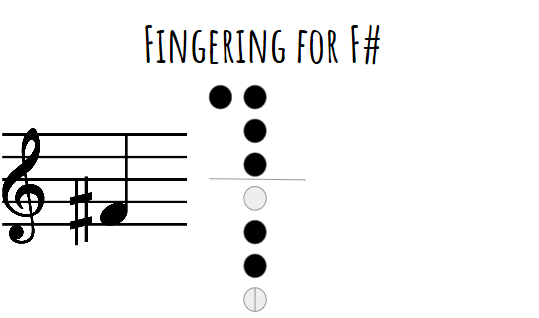
Did you miss me? 😉 Hopefully you had a fun and somewhat restful winter break! We are starting out 2019 learning a new note, F#, or pronounced, F-sharp. Here is the recorder fingering for F# to get you started:

This week’s episode is pretty straightforward. My biggest advice is for you to pause the episode any time you feel like we are going too fast. For example, if we are practicing the motion from F# to E and you are struggling, pause the video and practice at your own pace until you are ready to move forward! Generally I go through each exercise twice, but PLEASE understand that I do not anticipate everyone mastering a concept after two tries. I simply do that to keep the video moving along!

Also, for this lesson I put the accompaniment as a separate bonus video! Click here if you want to see the ukulele accompaniment!

The Lowdown on Low D

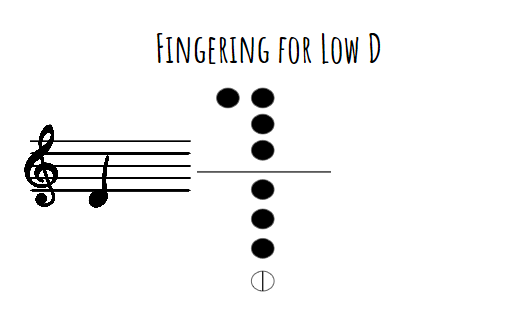
We are so close to getting through all right hand fingerings! For this week’s lesson, we are learning how to play low D. The biggest mistake in playing notes where you cover holes with your right hand is the tendency to overblow. This causes the dreaded squeak, so be sure you are thinking about blowing slow, gentle air! If you’re still squeaking, make sure your fingers are covering the holes! 

The fingering for D is pretty easy to remember since you cover all but one of the holes! Download the PDF version of this fingering chart for free here! 

I am about to be a traveler extraordinaire the next week and a half, so while there won’t be a video next week, the next blog post will be an intro to our next note we are learning, F#… that’s F-SHARP, not F hashtag! I just have to say that to all the younger readers ;-). Stay tuned and stay warm out there! 

Intro to Low E

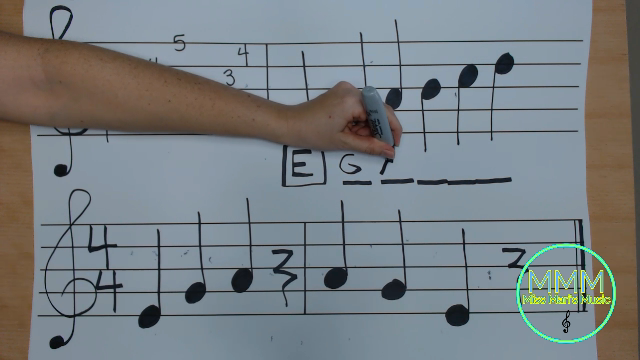
For TEN episodes, we have only used our left hand. Finally, we get to use our right hand for this week’s episode! We are starting right hand by learning first line E. You can download the visual below, as well as the corresponding visuals from the lesson for free from my Teachers Pay Teachers Store. 


For this lesson, I also did a quick review of both fingerings and position on the staff for G, A, B, C, and D. You will notice a portion where we fill in the note names together, just to be sure we’re all on the same page. 

I hope you enjoy this lesson as much as I did! Happy music making!

Why am I doing this? A note to music teachers…

On my week off, I’m feeling compelled to elaborate a little more about the purpose of my project, as well as what my project is not.  

If I were to be completely honest, the beginning of this project started because I miss teaching immensely. I will never forget the music educators  I had, from my first piano teacher teaching me middle C, to my college percussion professors, helping me get that perfect cymbal crash or using recording software to break down my playing, stroke by stroke. There were so many light bulbs they turned on for me, and I really want to give that to others! The teaching videos have been a way for me to hopefully turn on some light bulbs for people out there while I take time off to be at home with my toddler. 

When I was in the planning stages, I figured my videos would be a great resource for homeschool students or kids who don’t have a music program at their school. I hope to gain more traction with those populations over time, but as I have continued making videos I realized I really need to be supporting music teachers out there. 

This brings me to my next point, what this project is not…

Miss Mari’s Music is not intended as a replacement for school music programs. I will never, EVER replace a live music teacher. A quality, live music teacher offers so much I am unable to do through videos. Recorder lesson 1 is a few seconds shy of fourteen minutes, but in a class of thirty students, I guarantee it would take the entire fifty minute class period. When I’m teaching through a video, I am moving through the steps with the assumption that the end user is following all the steps correctly. The reality is that, we all have slightly different learning styles, absorbing verbal and nonverbal instructions differently from one another. A student with a similar learning style as me may get what I’m saying right away, while someone else will interpret my instructions in a different way. For example, if I say “left hand on top,” I would hope students interpret that to mean their left hand is at the top of the middle section of the recorder, but technically the “top” of the recorder is the head joint, so a student may put their left hand over the head joint. It happens! This is one example among hundreds of other examples I could give during a single lesson.

Here’s another example, but with a student that completely understands the teacher’s instructions as the teacher intended. The reality is that most people aren’t thinking about controlling parts of their bodies like their fingers, down to the angle of the pads of their fingers! This means that, even if a student DOES understand the directions I’m telling them to do, they may still not produce the desired sound because, while they think they are successfully doing something, such as completely covering the holes, they can be unsuccessful without realizing it because, when was the last time they have had to have control of the pads of their fingers? They think they are “doing everything the teacher’s telling me to,” but they still get that dreaded squeak because they’re still learning how to control parts of their bodies they haven’t had to think about before. Metacognition, anyone?

SO, back to what this project is for. Teachers, I want to help you. You have your pedagogical styles that work for you, and I’m not here to change that. I’m here to offer supplemental home materials that can be used to reinforce concepts covered in class. When I was in the classroom, I made a TON of videos like this that were much lower quality, and do you know what? Even without the fancy lighting and microphone, the students were watching them because they needed guided practice at home! Instead of taking more time out of your day to make videos, why not just use these free ones I have for you?

Another thing- sub plans – _ -. I would go in cycles of trying to make these elaborate sub plans with instructions on how to play certain singing games, instruments, etc., only to find out later that these instructions were very confusing for a sub, especially the 95% of them with no music background. Even for the subs with music backgrounds, unless they have a background in elementary music, the instructions for activities take some getting used to since the activities are so hands-on. When these sub plans didn’t work out, I would resort to movies under the veil of “educational” by making Disney musicals like Mary Poppins about the characteristics of a musical vs. an opera. The educational element was technically there, but I think we can all agree it is a bit of a stretch, especially when this is what the 2nd graders watched every time I had a sub! None of my video lessons are more than twenty minutes, so if you’re like me with a 50 minute block, I understand that leaves a lot of time, but what if your students could get 20 minutes of solid, productive educational instruction? Maybe the SUB could be learning along with the students in the video, so when the video is over the students could keep practicing and the sub could actually HELP them? Did I mention all of my sheet music visuals are available for free download on Teachers Pay Teachers? Just saying!

So yes, I’m still trying to make Miss Mari’s Music a resource for students who would otherwise not have access to music lessons (homeschool, schools without music programs), but I also want to be clear that I want to help all of you teachers too! I would be just as happy to offer a little bit of relief to teachers with students eager to learn! 🙂 If you are a music teacher and you do end up using the videos, I would love any feedback you could provide. 

Music teachers- I am sending all the warm wishes and positive juju I can! Don’t forget to go to bed early, store some fruits and veggies in your room to snack on in between all the treats the students are bringing you, and PLEASE drink lots of water! Bring a gallon a day if you need to. If you’re getting overwhelmed (as I constantly was), stop and remind yourself of all your students have accomplished so far! You got this! 
Giving Thanks

Do I still have a giant infection on my face? Yes. Does it look more gnarly as each day goes by? Yes! But guess what? I’m thankful. Here’s what I’m thankful for:

  • Doctors that make sure I’m getting the care I need
  • My parents and in-laws for stepping in and helping when I’m not feeling well
  • A house with a heater/insulation/furniture/hot water
  • Family that wants to be part of my life
  • Friends that check in with me
  • The resources to give music education to everyone! 😉

This week’s episode will help reinforce the fingering for G, A, B, C, and D by learning a classic holiday song- Jingle Bells! There are some skipping motions that will require extra practice, but this would be a great song to learn and perform for family and friends during the holidays!

A little side note- if you are a music teacher, I know this time of the year is INSANE! You are probably running around like crazy getting ready for holiday programs while trying to avoid all the germs spreading at school! If you find yourself (or your voice) needing a break, this is a great video that will teach a fun holiday song (maybe a bonus holiday belt for recorder karate?) while reinforcing music literacy. If you’re concerned about using YouTube, I recommend SafeShare where you can generate a link that doesn’t have all the video suggestions pop up at the end of the video or on the side bars. My videos are ad-free, but I know it is hard to control what YouTube suggests, and SafeShare is a great solution to that issue.

I’ll be off next week for Thanksgiving, but have a wonderful time with family and friends and enjoy the lesson!
Snapshot_28


The Thmb-less D!

For the first time in Miss Mari’s Music history, for Recorder Lesson 9, you are not using your THUMB!

Snapshot_24

Right? Unbelievable! Do you know what else is unbelievable? I’m still sick. In fact, it has actually gotten worse, and now I have an infection on my FACE! Lol. But what can you do? Life goes on, but this week’s lesson is much shorter than our normal ones. We will cover the fingering for fourth line D, then practice the transition from D to C. I hope you enjoy this short but sweet lesson! Keep on playing!

Taking the week off!

cold winter tablet hot
Photo by Pixabay on Pexels.com

Although I did film an episode for this week, I’ve decided to take a week off in order to recover from some sickness that has taken over the past couple of weeks. The time I usually spend editing videos and making visuals has been spent instead on the couch with lots of Kleenex and chicken soup! I’ll see you all next week for a lesson on our new note, D!

Creativity with Recorder

This week’s lesson is radically different! Instead of the typical dynamic where the student repeats after me, this week the student gets to decide what to play!

I remember the first time a teacher told me to improvise on a marimba. I was in a class with my peers, and I remember my body freezing. After years of playing exactly what a teacher told me to play, I thought I had no idea how to make up music on my own. I remember looking at the teacher thinking, “tell me what to do!” I wish the teacher told me that I had a HUGE toolbox to choose from! All those years of playing different styles of music on the piano in all the different key signatures had given me a wealth of vocabulary to improvise, but I had no idea I had it.

As an educator, I wonder what would happen if we started improvisation and composition much earlier than I did. What if we started it a few weeks into learning an instrument? I thought it would be interesting to teach improvisation and composition at an early stage in our learning because of the absence of choices; only four pitches and just a few note lengths to choose from. Maybe if we are given less choices, it isn’t as difficult to make one. If I went to an ice cream shop with fifty flavors of ice cream, it will be much more difficult than if they had five!

As a side note to my fellow music teachers, this week’s lesson was formatted for teachers either to use as a guide in teaching improvisation and composition, or to even use as sub plans if you would like an alternative to showing the educational music DVDs ;-). I have a PowerPoint presentation available for download here if you would like to save yourself a little time with lesson planning as well!

Don’t forget to post any questions or comments, and enjoy the lesson!
Snapshot_12

Brrr!

Maybe it is just in this part of the country, but it went from shorts and flip-flops on Sunday to Uggs and scarves on Monday! This week’s lesson features a song called Falling Leaves. The song uses skipping motion from third space C, with notes skipping first between C and A, then C and G. I thought of falling leaves because it reminds me of the way leaves fall from trees. Most of the time, they detach as wind is blowing, so they make their way to the ground via swirls up and down with the wind.

… But we don’t have that in Texas. In fact, even though the high has been in the 40s the past couple of days, the tree in my front yard is still full of green leaves! Go figure! Anyways…

If you have been patiently taking the lessons each week, I commend you! For the sake of being real, I feel compelled to emphasize a few things as we go through our music making journey-

  1. It is ok to pause, rewind, or even re-watch the episodes. While these videos are a great way to provide music education to everyone, I fully understand that these lessons are not going to be as individualized as having a live teacher with you. Here’s why. I’m sequencing these lessons based on my time in a classroom with 30+ students and their individual needs. This just means I’m trying not to go too fast, but also not too slow. HERE’S THE DEAL- in that class with 30+ kids, there are going to be 30+ different perspectives, learning styles, preferences, personalities, etc. I have basically taken the most common denominators between a class full of students and attempted to make a video that suits MOST people’s ability level. In a real classroom, the video lessons would take up the entire 50 minutes because I would be fixing each student’s mistakes individually. My former students could probably attest to the fact that a lot of times we wouldn’t even finish in 50 minutes because of the individual time I needed with each student. My point is, don’t beat yourself up if you need to pause, take a breather, re-watch, etc. This is normal and honestly I would assume 95% of true beginners watching this would need extra practice, especially when we start reading music.
  2. Ask questions in the comments! Really! Don’t be shy! I know there are people watching these lessons, and nobody has asked a question yet! If you ask a question about something I have already answered in a previous lesson, guess what? It’s totally fine because I’m covering a lot of information in these lessons! I won’t be mad, and even if I was, what can I do about it? I’m trapped behind a screen so I can’t get you 😉
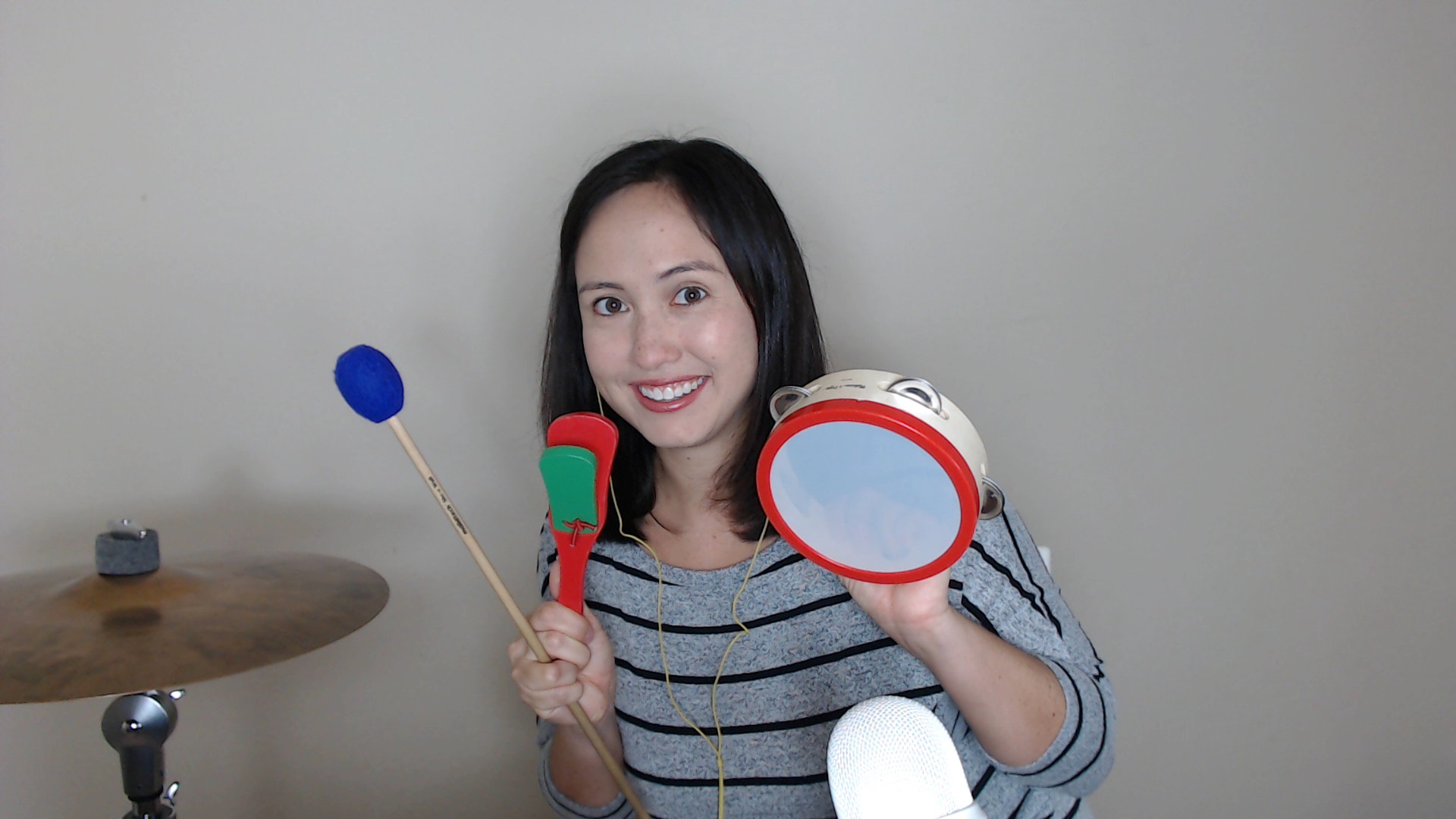
  3. Have fun. Don’t take yourself too seriously, really. For what it’s worth, here is a picture of me with some “real” percussion instruments, but also with toddler instruments because they actually sound pretty decent and I thought they would be a great accompaniment for this week’s song! Maybe someone might scoff at me using Melissa and Doug Band-In-A Box instruments for a music education video, but you know what… they aren’t the ones who get to have all the fun playing them! 🙂

Picture 14


The Funky C!

Ok, so the note itself isn’t necessary full of soul and makes you want to dance… but the way your fingers maneuver to get to the proper hand position may remind you of someone attempting the funky chicken!

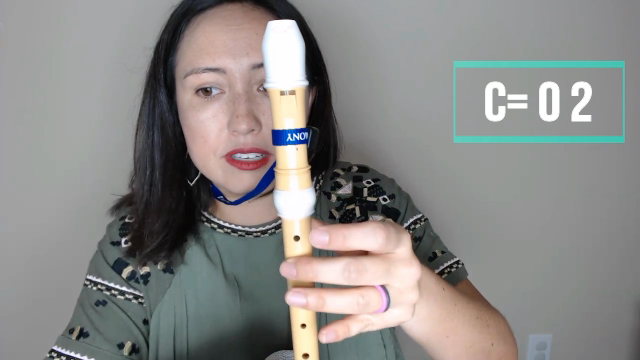
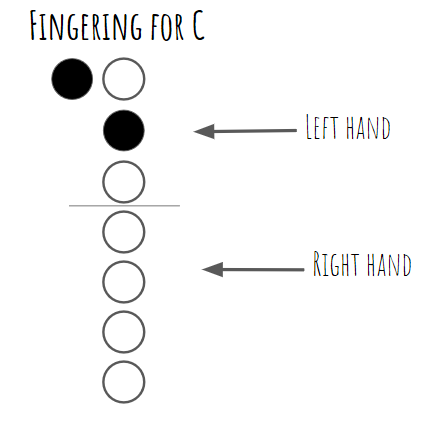
But really, learning the finger position for third space C is the beginning of weird recorder fingerings! What makes it unusual is the fact that, until now, you have always used 0 (left thumb) and 1 (left index finger) to play B, A, and G. All of a sudden, with C, you still use your thumb, 0, but you don’t use your index finger, 1!
Snapshot_5

Have no fear! In lesson 6, we will get lots of practice playing C correctly, in addition to transitioning from C to B, which takes a little coordination. Pretty soon you’ll be switching from C to B in your sleep :-).

Third Line C

If you want free hard copies of the music we will be learning, check out my Teacher’s Pay Teachers store where you can download and print the songs for free!

Don’t forget to either comment on the video or here with any questions you have!