Elevators and Skipping

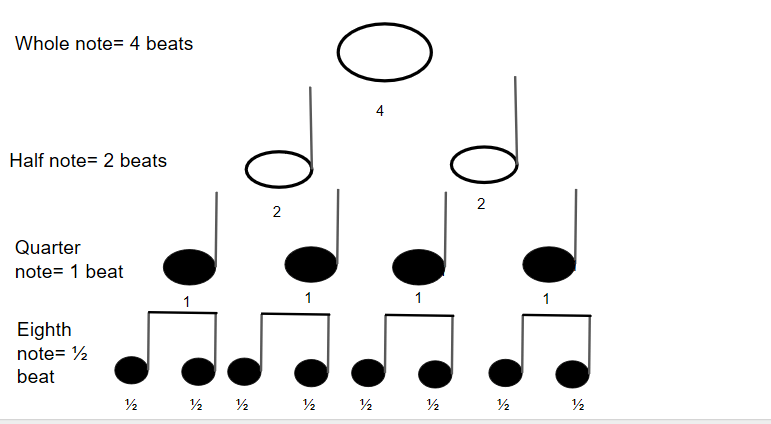
Recorder Lesson 5 is up! This week we are working on skipping motion, which means the notes played must skip another note on the staff to get to the desired note. In other words, going from G to B, skipping over A! Skipping motion requires more finger coordination, so a lot of the lesson is training your muscles to move the way you need them to! We also go over some new note lengths- half notes and whole notes. Half notes are two beats long, and whole notes are four beats long. In previous lessons, we worked on quarter notes, which are one beat long, and eighth notes, which are half a beat long.

Guess what? If you check out my Teachers Pay Teachers Store, you can download the visuals from the lesson for free! These are great to print off and post on a wall or bulletin board for visual reminders of note lengths. Here is one of the visuals that I love:

Rhythm Chart 1

I hope you enjoy my silly songs I composed this week, Elevator Jam! and Skippety Skip! I had a lot of fun making the accompaniment, as you can probably tell :-). Enjoy the lesson, and post any questions in the comments!

Picture 6


Ac-com-pa-ni-ment

Accompaniment! What is it, and why learn about it in Lesson 4? If you Google the definition of accompaniment, it is defined as a musical part that supports or partners a solo, voice, or group. Accompaniment is simply something fun to add to the recorder to make it fun and interesting! Aside from making it fun and adding depth to music, it also helps us make sure we are playing to a steady beat since we are collaborating with another musician or musical track.

The other part of our lesson focuses on tonguing. Tonguing is the interruption of airflow with, you guessed it- your tongue! Tonguing helps distinguish notes while keeping a consistent, clear tone quality. While this may sound like some sort of crazy magic trick that requires crazy coordination, you might be surprised to learn that you tongue all the time! Think about it- when you talk, what would happen if you didn’t have your tongue? You could probably still get the words out… but nobody would understand you!

This week’s lesson is fun because we are working on techniques and concepts that help create beautiful music. Accompaniment isn’t necessary ALL the time, but it can add wonderful depth to an instrument that is playing a beautiful melody, in our case the Ba-Ba Song and Hot Cross Buns!


G A B in Lesson 3!

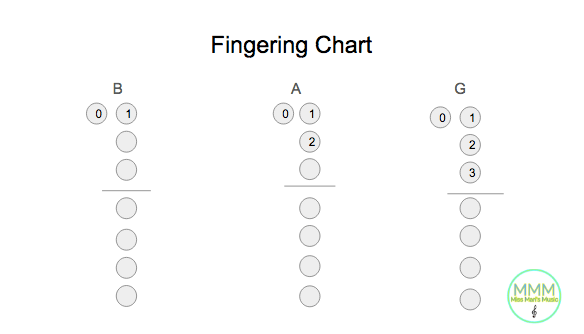
I hope you have been practicing! For lesson 3, we are learning the proper fingering for G, practicing moving our fingers between G, A, and B, and reading G, A and B on the music staff! As you add more notes, it is important to really train your muscles in your fingers to move the way you need them to! On my Teachers Pay Teachers page, you can find the free downloadable resources for lesson 3. I will eventually go over this in my videos, but something I added this week was a fingering chart. A fingering chart is simply a visual aide you can print and hang on your wall to help you remember the proper fingerings for each of the notes. As we learn more notes, I will update the fingering charts with the most up to date notes. Below is what this week’s fingering chart looks like. The single circle on the left of each note represents the hole on the back of the recorder, and the row of holes on the right represent the holes on the front of the recorder. The horizontal line separates right hand and left hand. The left hand covers the holes ABOVE the horizontal line, and the right hand covers holes BELOW the line. The numbers represent the number labels we have given our fingers (ex. thumb= 0, index finger= 1, etc.).

Screen Shot 2018-09-18 at 9.39.49 PM

Some tips for lesson 3!

  • As you begin to cover more holes, it is going to be easier to blow too fast and squeak! Be sure not to blow too fast!
  • When you learn Hot Cross Buns, it will help to rewind and practice along with the video a few times.
  • When the camera is on the music staff and you are playing, there will be times where you can distinctly see what holes my fingers are covering on the recorder, and other times where you can’t see my recorder at all. This has a purpose! My goal is for the student to be able to READ the notes on the staff instead of copying my fingers. I understand there are times where the student might want to get a visual reinforcement and make sure they are covering the correct holes, but the BEST way to know whether or not they are covering the correct holes is to listen with their ears and hear whether or not their pitch matches mine. If the pitch doesn’t match, from there you reassess whether it is a fingering issue or a blowing issue.
  • HAVE FUN!

This lesson will be a blast! Don’t forget to post any questions you have in the comments!

BA-BA Recorder!

Why BA-BA? No, I’m not talking about sheep! For lesson 2, we will be working on B and A. BA! When we start adding in additional notes besides B, in this case A, there is time that needs to be committed to switching between B and A in order to train our fingers and develop muscle memory. Hence BA-BA!

In lesson 1, we learned…

  • left hand on TOP!
  • Hold the recorder at a 45 degree angle
  • We label the thumb as 0, index finger as 1, middle finger as 2, ring finger as 3
  • To properly blow, imagine cooling off soup on a spoon. You don’t want to blow too hard and make the soup splash everywhere, but you also don’t want to blow too weak and still have burning hot soup. Whisper “too,” but don’t use your voice!
  • The pitch B uses 0 and 1, with 0 covering the back hole and 1 covering the front.
  • The two most common mistakes with a squeaky sound on the recorder are overblowing and not covering the holes completely with the pads of your fingers.

We also practiced call and response patterns between you and me. I changed the rhythm, or duration of each note, a few times while you played along.

In lesson 2, we will learn and demonstrate…

  • Fingering for A
  • Call and response patterns for A
  • Identifying A on the music staff
  • The difference between lines and spaces on the music staff
  • How to identify the lines and spaces on the music staff
  • Practice reading B and A on the music staff
  • Learn our first song- The Ba-ba Song!

As mentioned in the video, for next week’s homework, you are practicing parts 2-6. This includes the playing exercises we read from the staff. For your convenience, you can download the exercises and Ba-Ba song from my store at Teachers Pay Teachers. FOR FREE!Just a heads up, for now the exercises are literally photos from the video, but eventually I will get future lessons up as formal sheet music. Still working out some technical kinks! Downloading the sheet music is not necessary by any means, but it might make it easier to practice without having to be close to an internet connection for your entire practice session. It’s up to you! A little pause and rewind aren’t so bad if you don’t want to buy anything, either.

ENJOY and have fun on Lesson 2, and remember to post any questions you may have in the comments section either here or on YouTube!

Get ready to play!

I hope you have your recorders ready to go, because Lesson 1 is live on YouTube! Lesson 1 covers:

  • Proper hand position
  • How to blow properly into the recorder
  • Finger numbering system
  • Proper finger placement
  • Playing the note B
  • Call and response patterns
  • Common mistakes and how to fix them
  • Identifying B on the music staff

Here are a few tips:

  • Each person will master the concepts at a different pace. This is normal!  Please don’t feel like you need to watch the video from start to finish without pausing. In fact, I recommend you pausing and practicing each concept a bit before moving on with the lesson!
  • Keep a notepad and pencil close by. At the end of the episode, I will give you specific concepts to practice between lessons.
  • Ask me questions! Is there a word that confused you? Maybe you are trying to fix your mistakes with the techniques I mentioned, but you are still squeaking. Please comment so I can help! Your questions help me help you.

This lesson covers A LOT of information, but everything covered will help you get off to a great start! Good luck!

Summertime, and the livin’ is easy…

I heard that some of you have purchased your recorders and are ready for lessons! Way to go! I know you may be tempted to play it, but remember this-  it is so much easier to establish good habits than break bad ones. Lesson one, airing September 5th, will cover all the basics to get you started. We will go over proper hand position, how to blow correctly, and you will learn your first note! So get ready!

If it seems like I have not posted in a while, it is because I was on an epic road trip with my family the past two weeks. We covered NINE STATES! Texas, Louisiana, Mississippi, Alabama, Georgia, South Carolina, North Carolina, Tennessee, and Arkansas. Here’s a quick summary of our adventure:

  1. Vicksburg, Mississippi for lunch. Fun fact- I had never been to Mississippi, and I’m so glad we stopped. If you are ever there, check out the Catfish Row Children’s Art Park, which is right along the Mississippi River. Unfortunately, the splash pad was under construction, but my family enjoyed looking at the different murals painted on the levees that line the river. We were on a time crunch, but we were able to drive by a few interesting monuments from the Civil War. The city is nicknamed “The Key to the South” because of the turning point in the Civil War after the Confederate Army’s surrender of Vicksburg.
  2. Birmingham, Alabama for the night. I was shocked by the amount of mountains surrounding the city. It was my first time in Alabama, and I was pleasantly surprised by its natural beauty.
  3. Hilton Head, South Carolina for lots of time with family playing in the ocean.
  4. Savannah, Georgia for a historical tour. As a hobby I love learning about architecture and the way culture and historical events impact the design of buildings. Sorrel-Weed House, the home of a high ranking Confederate officer, was incredible! I think my favorite part was the courtyard, where the slaves that built the house imprinted their index and middle fingers into each batch of bricks they made. I feel like the slaves were so brilliant in leaving a little mark for us to remember them.
  5. Blowing Rock, North Carolina.  One of my favorite places in Blowing Rock is the Moses Cone Manor. The 13,000 square foot manor sits among thousands of acres of beautiful mountains and trees overlooking Bass Lake. The house was built in 1901 by Moses Cone, a textile entrepreneur, and its extensive trails are now taken care of through the National Park Service.
  6. Nashville, Tennessee to explore different museums and stay the night. I stumbled upon Lane Motor Museum while reading a blog about kid-friendly places in Nashville. There was a wonderful kids area with lots of toy cars for my little one, and my husband and I loved looking at the different collections of vehicles. Did you know that there is a vehicle that was designed to fit through a doorway? It was so tiny! My favorite section of the museum had cars made in Eastern Europe at the height of the Cold War and the rise of Communism. It was interesting to see how the economic struggles and limited resources of the Communist countries affected the design and materials used for the cars.
  7. Memphis, Tennessee for pork ribs. If you’re there, you must get the dry ribs at The Bar-B-Q Shop! They were delicious!

What a fun vacation! Episode one will be here soon, so don’t forget to grab a soprano recorder with baroque fingering for our first lesson! Take a look at my previous post for a comprehensive guide to purchasing a recorder.


New Episode Premieres September 5th!

Thank you for all of your support so far. Check out the teaser for my new channel by clicking here! Your subscription to my channel is appreciated!

We are starting season one with recorder, so if you need to get one, I recommend the Yamaha YRS-24B. It has a smooth, consistent tone quality and is very easy to clean. At $4.55 (plus tax and shipping), it is a great deal for a high quality instrument. I will be using the Yamaha 400 Series YRS-402B. This one is a little more pricey at $23.50, but I personally appreciate that the recorder is made from plant-based materials. You can’t go wrong with either one!

You certainly do not have to buy the ones I recommend, but just be sure whatever recorder you get is a soprano recorder with baroque fingering. Check your local music store, or go to West Music, where there is a large variety of soprano baroque recorders at different price points. Rhythm Band Instruments is another online retailer with a great selection of recorders. While it may be tempting to pick up a recorder in the dollar section at Target, but please don’t! Those recorders are TOY instruments, which means they are meant to mimic the sound of a recorder, but they are not designed to create the tone quality we will be working on.

Once you have your recorder, I know it will be temping to play it, but WAIT until September 5th so we can establish good habits together. If you don’t have your recorder, go get one, and I will see you soon!

How It All Began

First blog post alert!

Well well well…

This all started when I had a simple conversation with a complete stranger. I was in San Antonio for a music teacher conference. I didn’t have dinner plans with anyone one night, so I walked over to the HEB from my hotel to take advantage of a Thursday night pizza special they were having. As I was getting settled and about to bite into some delicious pizza, a woman, maybe a few years older than me, came and asked if she could join me.

Here’s the deal. I am completely fine eating by myself, especially if it is just the patio of a grocery store. I figured it would be more awkward to say no, and she didn’t seem creepy, so I thought, “sure, why not?” I told her a little bit about myself. I was visiting for a convention from out of town. I taught elementary music in public schools before deciding it was time to take a break from my job to stay at home with my little one. I told her that, while I was so thankful to be at home with my toddler, I missed teaching tremendously. I missed the unique way teaching gave me both a creative and analytical outlet. I loved the creative expression, and I also enjoyed the challenge of breaking down the creative process so that other people could experience the same joy I have experienced. I told her how I loved my little one so much, and I really wanted to go back to the classroom, but I just didn’t think it was the right time. She must have been really good at asking questions, because I guess I got kind of deep with this complete stranger.

Without any hesitation, she told me that I should start a blog and YouTube Channel. She told me that I had a lot to offer the world. She told me that, while my little one was napping, I could post videos that teach kids how to play instruments.

Wait.

What?

I have something to offer?

This was a lot to take in. Starting a video channel where I’m teaching musical instruments had never crossed my mind. I figured if I missed teaching, I could sub in some of the nearby elementary schools. But videos? Why? Why not?

When I was in the classroom, the most popular sentiment with my students was that they wanted to play instruments. There were the few that just preferred to sing the entire time, but for the most part, students expected instruments in an elementary music class.

I loved teaching instruments as much as I could, but I had some major limitations. Unfortunately, I think they are many of the same limitations other music teachers face, and I know I was one of the lucky ones.

My classes just kept getting bigger and bigger. For a few years I was given an aide to help offset the classroom management issues that come along with a larger class, but due to budget cuts I lost my aide. Being in a classroom where I was outnumbered sometimes as much as 33 to 1, I did the best I could to teach as much instrumental music as possible. With all the varying abilities and learning styles, I was limited in how much I could teach. I wasn’t able to give nearly enough personal attention to my students, and with nearly 600 students total, it was really difficult to sustain. Do you know what was much more attainable for huge classes? Singing. **Side note- this is NOT meant to discount the importance of singing. Singing is the cheapest and most accessible instrument to everyone. If you’re a vocalist reading this, I admire what you do! I simply know that I wish I could offer more instrumental opportunities for children.**

Anyways…

This is probably why most people associate their elementary music experience with singing, and maybe a few recorder songs here and there. Then there are those who didn’t have any music as part of their education at all. Like I said, I had limitations, but at least I had a job.

And then the light bulb turned on in my head. With today’s technology, I can help any child with an internet connection receive a high quality, elementary-level music education from my own home. I know this still excludes lots of children who do not have access to technology, but hopefully I can reach as many as possible. There are a lot of world problems I can’t solve on my own, but I can grant the opportunity to make music to as many kids as possible!

Teaser video coming soon!